 hemp
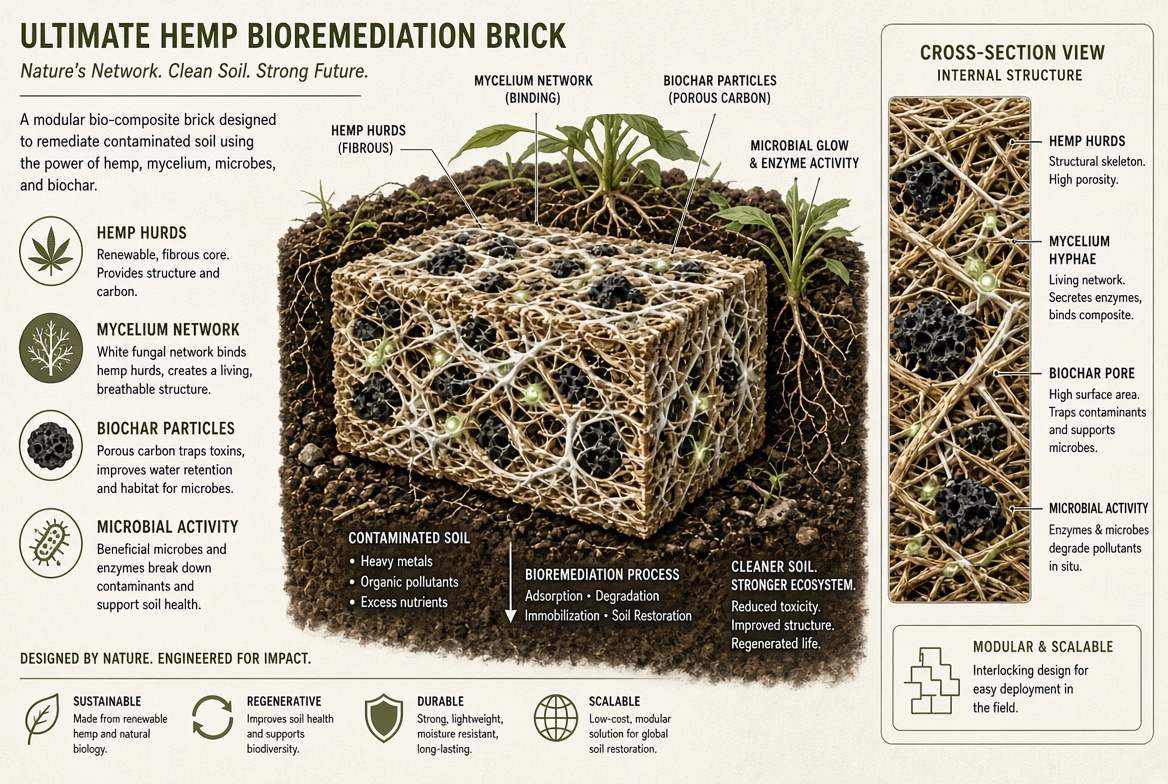
Could a plant-based composite support selected contaminated-soil treatment applications? Hempsphere’s bioremediation brick concept explores that question through a proposed combination of hemp hurds, mycelium, biochar and microbial activity.
Status: prototype in development. Not a commercial product, validated treatment or structural building brick.
What the concept proposes
The proposed brick gives several materials a modular form. Hemp hurds provide a plant-based framework. Fungal mycelium may help bind that framework. Biochar contributes porous carbon surfaces, while suitable microorganisms may support the transformation of some organic contaminants under suitable conditions.
The aim is to investigate whether that arrangement offers practical benefits for placement, contact with contaminated material and eventual management. It is not yet evidence that the ingredients remain effective when combined.
Reading the cross-section
The supplied infographic depicts hemp particles as a structural skeleton, mycelium hyphae as a binding network, biochar particles with pores, and areas representing microbial activity. It is a concept illustration, not a microscopy image or a record of measured performance. Glowing elements are visual devices; microbes do not need to glow for treatment to occur.
The finished structure will depend on the actual formulation and manufacturing process. Strength, porosity, water movement, material stability and biological activity all need to be measured rather than inferred from the picture.
Different mechanisms, different claims
Adsorption holds substances on material surfaces. Its performance depends on both the substance and the material, as well as soil chemistry and contact conditions. Capture does not necessarily destroy a contaminant.
Biodegradation can transform susceptible organic compounds through biological processes. It must be demonstrated for the particular contaminant and conditions. Loss of the original compound is not enough on its own; intermediate products and residual toxicity can matter.
Immobilisation seeks to reduce mobility or availability. That is different from removing contamination. A change in environmental conditions may alter whether a substance stays immobilised.
Heavy metals cannot be biodegraded. They may be captured, moved, accumulated or changed in chemical form, but the elements remain. A project needs an appropriate plan for metal-bearing materials and any residues.
What would a useful test show?
Start with a defined contamination problem and a baseline soil analysis. Use suitable controls and representative conditions. Compare the composite with untreated soil and relevant component treatments so that any effect can be attributed meaningfully.
Measure changes in contaminant concentration or availability using appropriate methods. Check leaching, treatment by-products, effects on soil organisms, physical deterioration and the survival or activity of the intended biological components.
Testing also needs a retrieval or end-of-life plan. A brick that captures contaminants could become a contaminated material itself. Its disposal or further treatment cannot be assumed safe because the original ingredients were plant-based.
Potential advantages to investigate
A modular format might simplify placement, tracking and recovery. Plant-derived ingredients may offer useful material properties. Biochar and biological processes create interesting research questions. None of these possibilities establishes low cost, durability, scalability or a net environmental benefit.
Those outcomes need evidence, including manufacturing inputs, transport, replacement frequency and spent-material handling. “Regenerative” is an ambition to test against measurable outcomes.
Soil and river applications are different
The concept should not be treated as a ready-made river filter. Flowing water introduces questions about erosion, particle release, contact conditions, aquatic effects and recovery. A formulation suited to one soil application could behave differently when submerged or exposed to repeated wetting.
Any future evaluation needs to follow the contaminants through the system: what remains in the environment, what attaches to the material, what is transformed, and what leaves as a residue. Capturing a substance without managing the spent material is not a complete remediation pathway.
Plant-based feedstocks are not automatically safe after use on contaminated land or water. Conversion into char does not establish that metals or other contaminants have been destroyed. Analytical characterisation and an appropriate end-use assessment are needed before proposing reuse.
Read our guide to source control, monitoring and the biomass ledger.
The next milestone
The credible next step is a defined formulation tested against a defined problem, followed by independent assessment and appropriate field evaluation. This page will distinguish concept work from verified results as development progresses.
Background reading
US EPA: Phytoremediation Resource Guide explains related removal, degradation and containment mechanisms. It does not validate Hempsphere’s composite.
Research & Development · Materials catalogue · Research enquiries